

The most correct answer to the question “Is Azure Container Apps the best cloud-native alternative for .NET developers?” is: It depends! However, that answer doesn’t give any value. So let me elaborate further on my reasoning.
What is Cloud-Native?
Cloud-native is a set of best practices for developing efficient software for cloud-based applications. While there is no strict definition, there are several aspects that must be met:
- Technology: At the core of cloud-native applications is Kubernetes. Kubernetes, as a technology, enables the primary benefit of cloud-native applications: cloud portability. Being cloud-native means you keep technical debt under control, and a significant portion of this debt is related to the selection of the cloud provider.
- Architecture: Running a monolith in a container does not make it a cloud-native application. Cloud-native applications are typically distributed systems with an architecture similar (though not necessarily identical) to microservices.
- Organization: Being agile and having the DevSecOps process automated, monitored, and continually improved is a key organizational aspect of cloud-native applications.
While Kubernetes addresses the cloud portability requirement, it also introduces a significant learning curve and complexity. As a result, numerous applications and products aim to bridge this gap — most of them part of the Cloud Native Computing Foundation (CNCF). The goal of the CNCF is to bring cloud-native applications closer to a broader audience.
The Cloud-Native Alternatives in Azure
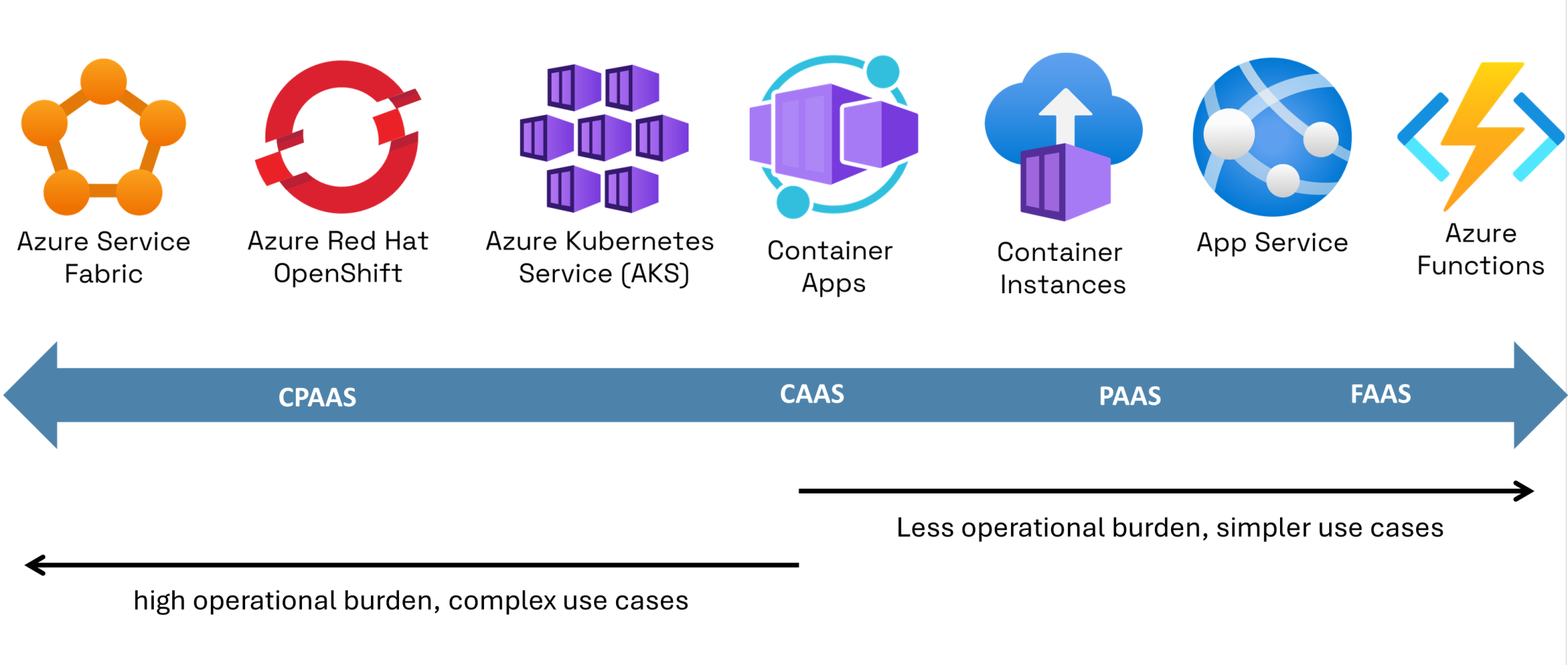
Going cloud-native and selecting the matching technologies is not an easy task. Looking at the cloud-native alternatives in Azure, there are several different options, ranging from high-complexity to low-complexity:
- High complexity: Azure Red Hat OpenShift, Azure Kubernetes Service (AKS) — fully managed Kubernetes
- Middle ground: Azure Container Apps (ACA) — serverless, managed container platform
- Low complexity: Azure Functions — pure serverless, event-driven compute
I intentionally place Azure Container Apps in the middle because it strikes a great balance between complexity and cost.
Azure Container Apps (ACA)
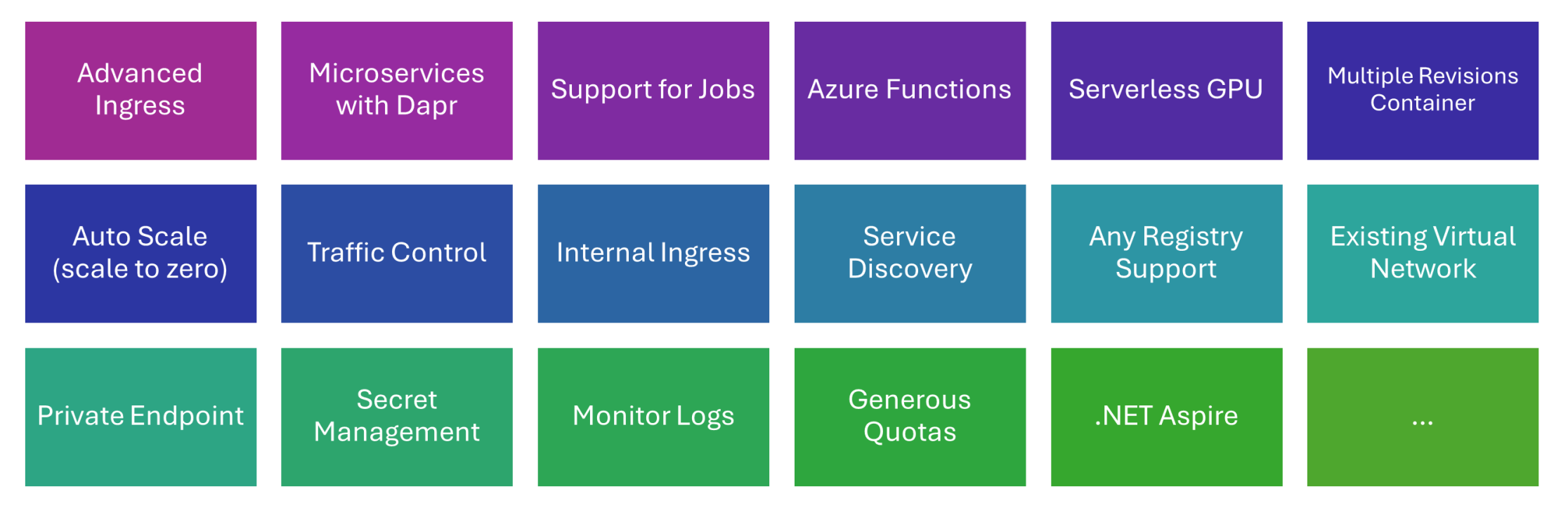
Azure Container Apps (ACA) is a serverless, managed container platform built on Kubernetes but hiding the complexity. ACA comes with a large set of built-in features that significantly reduce the learning curve and management complexity of Kubernetes. While covering the most common use cases and architectures, ACA is serverless — a significant advantage compared to Kubernetes services, which require a layer of virtual machines (VMs) to run properly regardless of load.
Why ACA for .NET?
Besides the serverless benefits and simplified Kubernetes complexity, ACA has excellent built-in integration with .NET, which makes local development of cloud-native applications much easier and simplifies the transition from a local environment to Azure and back. Three technologies make this happen:
Dapr
Dapr is a set of integrated APIs with built-in best practices and patterns to build distributed applications. Dapr increases developer productivity by 20–40% with out-of-the-box features such as workflow, pub/sub, state management, secret stores, external configuration, bindings, actors, distributed lock, and cryptography. Developers benefit from built-in security, reliability, and observability capabilities — no boilerplate code required. Azure Container Apps are fully integrated with Dapr sidecar containers, so no extra configuration is required.
.NET Aspire
.NET Aspire is an opinionated, cloud-ready stack for building observable, production-ready, distributed applications. It is delivered through a collection of NuGet packages that handle specific cloud-native concerns, and it integrates natively with Azure Container Apps deployment.
Azure Developer CLI (azd)
The Azure Developer CLI (azd) is an open-source tool that accelerates the path from a local development environment to Azure. azd provides developer-friendly commands that map to key stages in the development workflow (code, build, deploy, monitor). Combined with .NET Aspire, azd up deploys your entire distributed application to ACA in a single command.
Is ACA the Best Cloud-Native Alternative for .NET Developers?
Again, it depends. Here is what it depends on:
If your organization already has a Kubernetes-based engineering platform: You have to follow that path. In that case, the serverless and Kubernetes-less management are not relevant arguments.
If you are building a greenfield project in an organization just starting with cloud-native development, your decision depends on:
- The know-how of your team
- The organization’s vision
- If you already have a Kubernetes expert in your team, and the organization will need an engineering platform eventually, start with Azure Kubernetes Service early.
- If you have a strong .NET development team and the organization is not yet clear on its path, Azure Container Apps is the best Azure cloud-native alternative.
In most scenarios, I recommend Azure Container Apps. It is serverless, deeply integrated with .NET tooling, and significantly reduces the operational complexity that would otherwise require a dedicated platform engineering team.
Links Azure Developer CLI